REVIEW · PHNOM PENH
Full-Day Phnom Penh Tuk Tuk City Tours
Book on Viator →Operated by Royal Phnom Penh Tours · Bookable on Viator
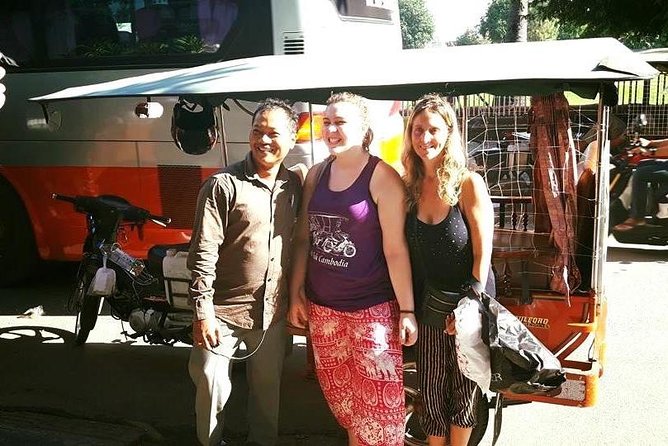
Phnom Penh in one day can feel intense. This full-day tuk-tuk loop mixes royal Cambodia with the hardest chapters of the 20th century, with a guide helping you connect the dots at places like the Royal Palace, Wat Phnom, and the genocide sites—while hotel pickup keeps the logistics easy.
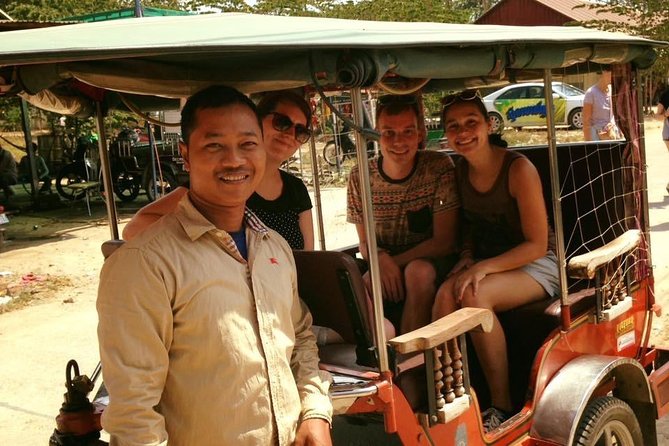
I love the private tuk-tuk approach for a day like this. You get dedicated transportation for about 7 to 8 hours, and all entrance fees are included, so you spend less time managing details and more time actually seeing the city.
One consideration: this is a long day with very heavy stops. Tuol Sleng and Choeung Ek are emotionally intense, and lunch is not included, so you’ll want to plan around that.
In This Review
- Key highlights worth your attention
- A Phnom Penh day you can actually finish: tuk-tuk logic
- Royal Palace and Silver Pagoda: where Cambodian power and art meet
- Wat Phnom: the city’s hill story in plain sight
- Tuol Sleng and Choeung Ek: when the day gets very hard
- Central Market and independence-era monuments: Phnom Penh beyond museums
- Food and timing: how to handle lunch without losing the day
- Price and value: what $84.11 actually covers
- Guides and the personal connection that changes the tone
- Who should book this Phnom Penh tuk-tuk day
- Should you book Royal Phnom Penh Tours’ full-day tuk-tuk city loop?
- FAQ
- How long is the Phnom Penh full-day tuk-tuk city tour?
- Is hotel pickup and drop-off included?
- What transportation do I use during the tour?
- Are entrance fees included?
- Is lunch included in the price?
- Which main sights are visited during the day?
- Is this tour private?
- Do I get an English-speaking guide?
- Is visa arrangement included?
- Is free cancellation available?
Key highlights worth your attention
- A private tuk-tuk route designed to pack in the big Phnom Penh sights in one day
- Hotel pickup and drop-off, which saves you time in a city where traffic can eat plans
- All entrance fees included, including major museum and temple tickets
- English-speaking guide, with personal, human storytelling (you may meet guides like Ms Chheang Sreyneang or Channy)
- The day’s pacing includes both beauty and tragedy, from Royal Palace glamour to Tuol Sleng and Choeung Ek
- Cold bottled water during the trip helps on a warm Cambodian day
A Phnom Penh day you can actually finish: tuk-tuk logic
Phnom Penh is not huge, but your time can disappear if you’re bouncing around with taxis and figuring out where to start. This tour’s big idea is simple: make the whole day run in a single connected route, using a private tuk-tuk to move you between major landmarks without turning your trip into a transport chore.
You’re out for about 7 to 8 hours, which is enough time to get a real sense of the city. It’s also long enough that the choice of stops matters, because you’ll be staring at them from inside one continuous day: morning begins at the royal and temple sites, then the tour pivots toward the most difficult museums in Cambodia.
The private setup is a practical win. You’re not squeezed into a larger group plan, and you can keep your questions going with your guide. And since it includes hotel pickup and drop-off, you avoid the end-of-day scramble that so often turns a good day into a stressful one.
You can also read our reviews of more city tours in Phnom Penh
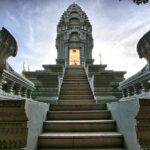
Royal Palace and Silver Pagoda: where Cambodian power and art meet
You start with the Royal Palace complex, and that’s the right move. It’s the city’s most structured, most formal space, and it gives you a baseline for how Cambodia has presented royalty, religion, and national identity through time.
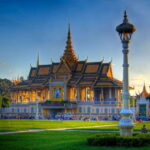
At the Royal Palace, look for the big visual punch: the Throne Hall area and its 59-meter tower, with a roof that’s described as decoratively decorated. Even if you only spend about an hour here, the palace isn’t just one building—it’s a whole atmosphere, with architecture doing the talking.
Then you move to the Silver Pagoda (Wat Preah Keo Morakot). This is in the southern portion of the Royal Palace complex. The name Silver Pagoda comes from the striking flooring theme, but the more interesting part is context: it was formerly known as Wat Uborsoth Rotannaram, connected to the king’s worship there. In other words, this is a site that ties together daily sacred life and national presentation.
What I like about this pairing is that it doesn’t feel random. Palace first, then a sacred space inside the same royal precinct. You leave with a clearer sense of how the royal complex functioned as both a political statement and a religious stage.
Wat Phnom: the city’s hill story in plain sight
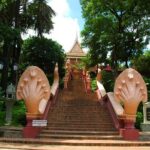
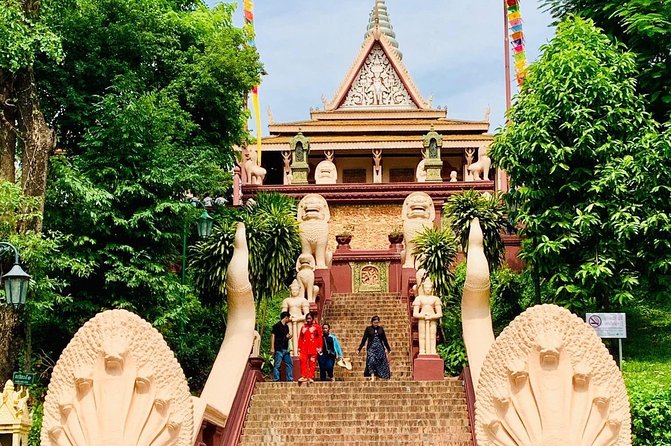
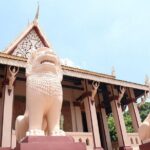
Next comes Wat Phnom, which is different from everything earlier. It sits on top of a tree-covered knoll about 27 meters high, and the tour frames it as the only hill in Phnom Penh. That matters, because you get the feeling of a place that’s been set apart from the flat city.
You’ll hear the legend that the first pagoda here was erected in 1373 to house four Buddha statues deposited at the site. Even if you don’t treat legends as literal history, you should treat them as local memory. In Cambodia, these stories are part of how people understand place—why a temple is located where it is, and what it means for the community that surrounds it.
A practical note: this stop is shorter, around 40 minutes. That’s enough for the viewpoint, the atmosphere, and the core story, without turning your day into an hour-by-hour temple marathon.
Tuol Sleng and Choeung Ek: when the day gets very hard
After Wat Phnom, the tour turns toward Cambodia’s tragic modern history, and it does so in the way that actually helps you understand the bigger picture.
First is Choeung Ek Genocidal Center (often linked to the Killing Fields). The information given on the tour points to the period between 1975 and 1978, when about 17,000 men, women, children, and infants (including nine westerners) were detained, tortured, and then transported to their deaths. Hearing those numbers in context changes the tone of everything around you, because you stop seeing it as a site and start seeing it as a system.
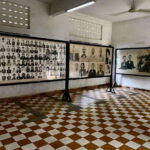
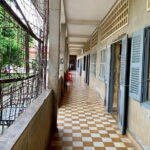
Then the day moves to Tuol Sleng Genocide Museum (S-21). This is tied to how prisoners were held and processed. The tour explains that in 1975, a school—Tuol Svay Prey High School—was taken over and turned into Security Prison 21, which became the largest detention and torture center of its kind in the country at that time.
Why this matters: by pairing these two places in one day, you get a clearer sequence—detention and torture, then extermination. If you’re someone who gets overwhelmed by museums, you’ll still find this pairing more manageable than visiting only one side of the story. You can keep asking your guide questions without feeling like you’re missing half the chain.
Plan a slow internal pace here. The tour blocks about 1 hour 30 minutes for each of these stops, which is long enough to absorb details but short enough that you’re not stuck forever in one room. If you need to step back, that’s normal. Take it. No one benefits from rushing this.
Central Market and independence-era monuments: Phnom Penh beyond museums
After the museums, the city can feel like it opens up again. You’ll head to Central Market, an Art Deco landmark completed in 1937, with a bright yellow building and a 26-meter central dome. The tour also notes that four tall arch-roofed arms branch out diagonally—so it’s not just a place to shop, it’s a recognizable piece of urban design.
This is your breathing-space stop, and it helps you remember that Phnom Penh is still a working city. Even if you don’t buy anything, you’ll see how locals move through everyday life—vendors, shoppers, and the constant hum that doesn’t pause for historical weight.
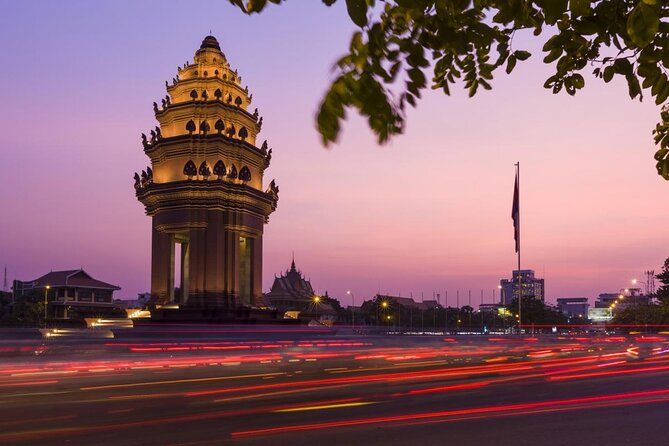
From there, the itinerary includes an Angkorian-style tower in the heart of the capital. It’s described as being built in 1958 to celebrate Cambodian Independence Day after regaining independence from the French. It’s a reminder that national identity in Phnom Penh isn’t only framed by museums. It’s also built into monuments.
Finally, you visit the Norodom Sihanouk Memorial. The tour description gives concrete details: a bronze statue 4.5 meters tall under a 27-meter-high structure. If you like monuments that feel like they have a physical presence, this one lands.
Together, Central Market plus these national identity stops do something useful: they bring you back to Phnom Penh as it exists now—trade, symbols, and public space.
You can also read our reviews of more tours and experiences in Phnom Penh



Food and timing: how to handle lunch without losing the day
Lunch is not included. Instead, your tour guide recommends a good local restaurant. That’s a smart setup because your guide can match the meal to your preferences and the day’s pace.
Here’s how I’d handle it: pick lunch based on practical needs, not just sightseeing needs. You’ll likely want something quick and filling before you head toward the later part of the route. If you’re sensitive to heat, choose an airier spot and plan to slow down a bit after the museums.
Also, remember the tour includes cold bottled mineral waters during your trip. That helps, but it’s still a full day in warm weather. If you’re prone to getting dehydrated, treat the water as part of your routine, not a special treat.
Price and value: what $84.11 actually covers
At $84.11 per person, this tour is priced like a day you don’t want to manage yourself. The reason it can feel like good value is the bundle: you get private tuk-tuk transportation, English-speaking guiding, hotel pickup and drop-off, cold bottled water, and all entrance fees.
That last part is the sneaky value. Temple and museum tickets add up fast when you’re paying multiple times and then waiting in lines. Here, the admissions are handled as part of the plan, so you’re not constantly stopping to figure out where to buy and whether you’re at the right window.
Is it expensive compared to solo entry tickets? Sure, if you’d happily travel on your own and you’re okay with juggling route planning. But if you want the day to run like a coherent storyline—from palace to hilltop temple to the genocide museums—this price starts to make sense.
One more value angle: it’s often booked about 15 days in advance, which usually means the operator is running regularly enough to cover demand. It’s also a sign that if you’re traveling during a busy period, you shouldn’t wait until the last minute.
Guides and the personal connection that changes the tone
A full-day tour is only as good as the person steering the story. The tour’s standout element from the guide side is that some guides bring not just facts, but personal connection.
You might meet guides such as Ms Chheang Sreyneang, described as exceptional in knowledge and patience—someone who keeps questions welcome and helps the day move without dull moments. Another guide called Channy is praised as sweet and very knowledgeable, which matters because this route includes both formal architecture and hard-hitting historical sites. One guide is also noted for having a family that lived through Pol Pot times, adding a human weight to the history you’re being shown.
If you’re the type of traveler who likes to ask, then asking is part of the value here. This is the kind of route where small explanations can change how you read a building or understand a museum display.
Who should book this Phnom Penh tuk-tuk day
This tour fits best if you want:
- One efficient day to cover the main Phnom Penh highlights
- A guided narrative that connects the city’s royal sites with its modern tragedy
- A private tuk-tuk experience with pickup and drop-off, so you don’t spend your day negotiating transport
- Someone who can recommend local food for lunch rather than leaving you to guess
It might be less ideal if:
- You strongly dislike heavy history and know you’ll struggle with the tone at Tuol Sleng and Choeung Ek
- You want an unstructured day with long stays at each stop. Here, the schedule is built for breadth.
In short, if you want the big Phnom Penh hits with minimal fuss, this works. If you want only light sightseeing, you may want to plan a different route.
Should you book Royal Phnom Penh Tours’ full-day tuk-tuk city loop?
I’d book this tour if you’re doing Phnom Penh on a time crunch and you want your day to feel purposeful. The combination of Royal Palace, Silver Pagoda, Wat Phnom, and then the museum sequence gives you a balanced portrait of Cambodia in a single day.
The key decision point is emotional. If you’re okay with hard content and you’re ready to let the day shift tone, this is one of the best ways to see Phnom Penh without wasting hours on logistics.
If you want an easy, guided hit-list day with private comfort and admissions handled, book it. If you’re looking for a relaxed stroll with zero heavy stops, skip this one and choose a lighter day instead.
FAQ
How long is the Phnom Penh full-day tuk-tuk city tour?
It runs about 7 to 8 hours.
Is hotel pickup and drop-off included?
Yes, hotel pickup and drop-off are included.
What transportation do I use during the tour?
You travel by private tuk-tuk.
Are entrance fees included?
Yes. All entrance fees are included.
Is lunch included in the price?
No. Lunch is not included, and your guide will recommend a good local restaurant.
Which main sights are visited during the day?
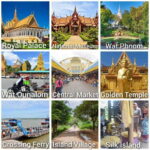
The tour includes the Royal Palace, Silver Pagoda, Wat Phnom, Choeung Ek Genocidal Center, Tuol Sleng Genocide Museum, Central Market, an Angkorian-style independence tower, and the Norodom Sihanouk Memorial.
Is this tour private?
Yes. It’s a private tour/activity, and only your group will participate.
Do I get an English-speaking guide?
Yes, an English-speaking tour guide is included.
Is visa arrangement included?
No. Visa arrangement is not included.
Is free cancellation available?
Yes. You can cancel up to 24 hours in advance for a full refund. If canceled due to poor weather, you’ll be offered a different date or a full refund.