REVIEW · SIEM REAP
2-Day Angkor Wat and Banteay Srei with Countryside Exploration
Book on Viator →Operated by Asean Angkor Guide · Bookable on Viator
The 4:30 alarm pays off. This 2-day Angkor Wat and Banteay Srei tour starts with a sunrise slot at Angkor Wat, then keeps things moving through the iconic sights with clear storytelling from guides like Sam, Sinan, and Mony. I love that the schedule includes a local family breakfast stop near Srah Srang, so the temples don’t feel like they sit in a bubble.
I also like the practical comfort: hotel pickup, an A/C minivan, and cold water plus cool towels during the day. That matters on Temple Day 1, because you’re up before dawn and walking in warm weather for hours.
One thing to plan for: this is a physically long day even split across two dates. Day 1 begins between 4:30 and 5:00 am, and you’ll need an early night and the right temple clothes (knees and shoulders covered, no shorts).
In This Review
- Key highlights that make this tour work
- The Angkor Wat sunrise start (and why that early pickup is the whole deal)
- Day 1 temples: from Srah Srang breakfast to Bayon’s Buddha faces
- Angkor Wat at sunrise
- Srah Srang: breakfast with a local family restaurant
- Pre Rup: brick Hindu temple views
- Ta Prohm: the jungle temple with roots
- Angkor Thom South Gate (Victory Gate)
- Bayon: smiling faces and over 200 Buddha carvings
- Day 2 countryside exploration: temples outside the main circuit
- Preah Khan: a major Buddhist temple
- Neak Pean: an artificial island temple
- Ta Som: smaller scale, late 12th-century context
- Eastern Mebon: an island temple on dry reservoir ground
- Lunch at Angkor Archaeological Park
- Banteay Srei: why this carved sandstone temple feels different
- The Cambodian Landmine Museum: a short stop with real weight
- Price and value: $160 for the tour, plus what you still need to budget
- Comfort, guide style, and the small-group feel
- Dress code and what to pack for temple days
- Who should book this 2-day Angkor Wat and Banteay Srei tour
- Should you book it?
- FAQ
- Do I need an Angkor pass for this tour?
- What time is pickup for Angkor Wat sunrise?
- Is breakfast and lunch included?
- Are temple entry tickets included?
- Is the Cambodia Landmine Museum ticket included?
- Is hotel pickup and drop-off included?
- Can I request a vegetarian meal?
- What’s the dress code for the temples?
Key highlights that make this tour work
- Angkor Wat sunrise timing: early pickup means you’re positioned before the crowds really swell.
- Srah Srang breakfast stop: a real local meal at the start, not just a snack-on-the-go.
- Jungle textures at Ta Prohm: trees and giant roots left in place create a very specific mood.
- Smiling faces at Bayon: the famous towers filled with Buddha faces become easier to understand with a guide’s layout tips.
- Banteay Srei later in the day: smaller, detailed carvings feel like a different kind of Angkor.
- Landmine Museum on the way back: a short, sobering stop that adds context beyond the stone temples.
The Angkor Wat sunrise start (and why that early pickup is the whole deal)
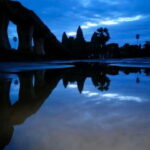
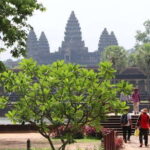
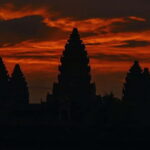
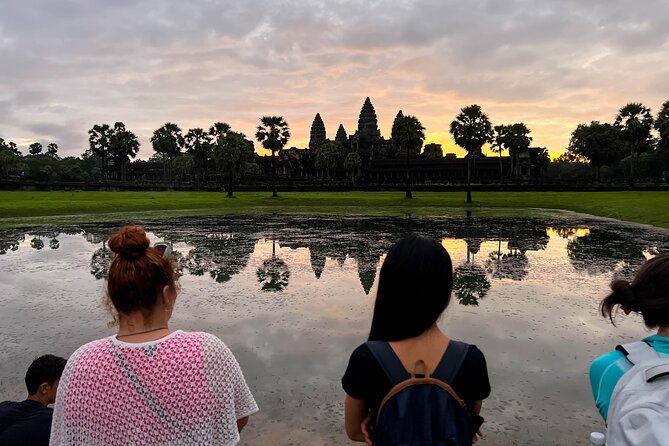
Angkor Wat at sunrise is not just pretty. It’s when the site feels most readable—light hits the stone, shadows sharpen the angles, and the whole complex looks like what it’s meant to be: a designed landscape of faith and power. Doing it early also helps you avoid the worst of the chaos that builds later in the morning.
This tour picks you up from your hotel lobby before sunrise, between 4:30 am and 5:00 am on Day 1. That timing is a big value point because you’re not wasting precious vacation hours trying to get there and find a good spot. You’re also not stuck waiting around with a tired group.
There’s one rule that matters here: the Angkor pass is required before the tour starts. The operator explicitly asks you to have the pass before sunrise so nobody misses the early viewing window. If you’re the type who likes to sort things last-minute, do yourself a favor and handle the pass ahead of time.
Finally, remember: temples open early, but your body might not. Light layers are smart. The dawn air can feel cooler than the later sun, especially when you’re standing still for sunrise photos.
You can also read our reviews of more tours and experiences in Siem Reap

Day 1 temples: from Srah Srang breakfast to Bayon’s Buddha faces
Day 1 is the classic Angkor circuit, and the order is designed to give you variety fast: major skyline moments, then calmer temple spaces, then the big central Angkor Thom highlights. It’s a long day, but the pacing keeps you from getting numb to temple sights.
Angkor Wat at sunrise
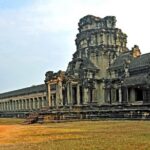
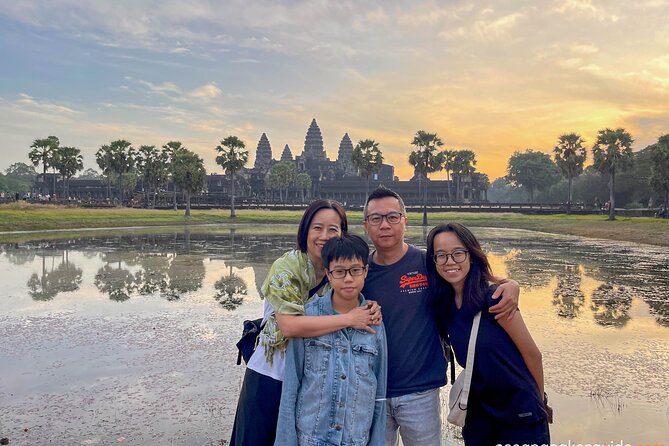
You’ll spend about 2 hours at Angkor Wat for sunrise viewing. The point isn’t only seeing it once—it’s getting to see how the light changes the carvings and walls over a relatively short window. Expect a mix of standing, slow walking, and photo stops.
What you should do: wear sunscreen under your hat, but also bring something that covers your shoulders and knees. The tour has a strict dress code, and you don’t want to start the day adjusting clothes at every stop.
Srah Srang: breakfast with a local family restaurant
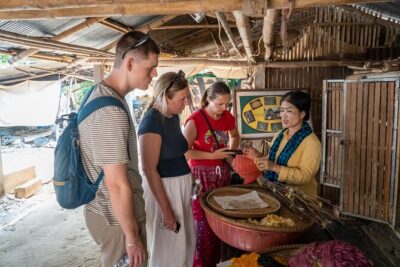
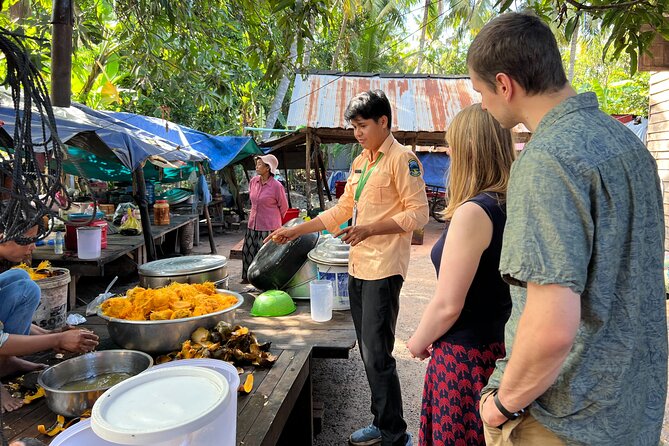
After the sunrise, you’ll shift gears with breakfast at a local spot in Siem Reap tied to the Srah Srang area. This stop is included and focused on real food rather than a quick bottled-water break.
Why this matters: it breaks the “temples-only” rhythm. You’ll see how local families work around the tourist flow, and you’ll feel more human before you start the next wave of ruins.
Pre Rup: brick Hindu temple views
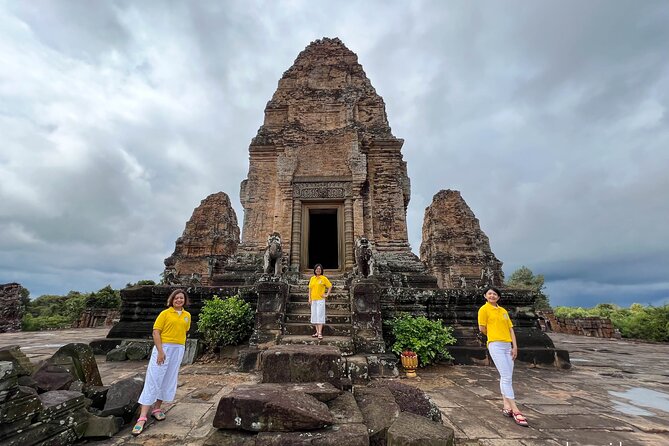
Next is Pre Rup, described here as the largest brick Hindu temple in Angkor Park. You’ll be there for about 40 minutes. This is one of those temples where the guide’s explanation helps you notice the structure and orientation, not just the stones.
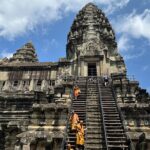
Trade-off: it’s another stop that relies on you standing and climbing small sections. If your legs are already tired from sunrise, move slowly and take the rest breaks when offered.
Ta Prohm: the jungle temple with roots
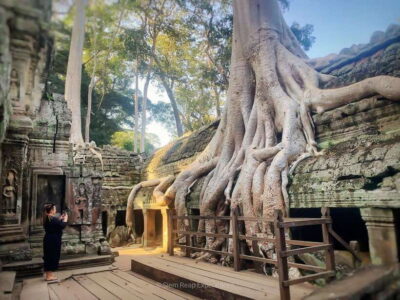
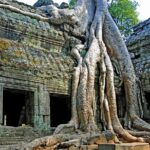
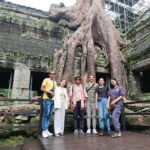
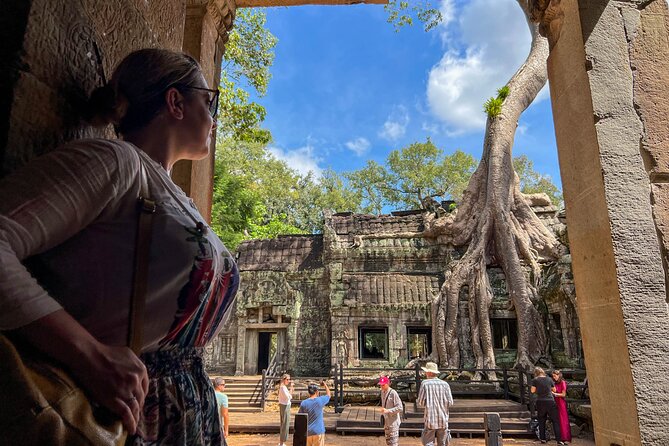
Then comes Ta Prohm, the jungle temple left partly in its original state with huge trees and roots. You’ll get about 1 hour here.
This is one of the stops where the “photo moment” can be misleading—Ta Prohm is more interesting when you slow down and let the roots and overgrowth frame the carvings. A good guide helps you orient yourself so you’re not just shooting random corners.
Angkor Thom South Gate (Victory Gate)
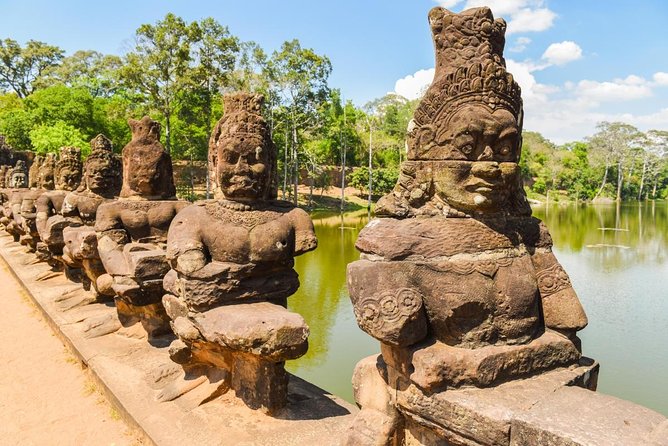
A quick visit follows at Angkor Thom South Gate, famous as the Victory Gate, decorated with statues of demon and god. The stop is short—about 15 minutes—but it’s worth treating it like a gateway lesson. The gate imagery is a theme marker for what you’re entering.
Bayon: smiling faces and over 200 Buddha carvings
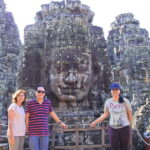
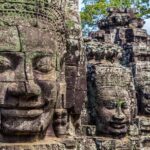
Finally on Day 1 is Bayon, where you’ll spend about 1 hour. The hallmark is the smiling faces—this tour notes more than 200 Buddha faces carved on the towers.
What to expect: more crowd than some other sites, and more walking than it looks on a map. If you feel overwhelmed, focus on learning the layout from your guide first, then use that mental map to pick photo angles.
At the end of Day 1, you’ll transfer back to your hotel in Siem Reap.
Day 2 countryside exploration: temples outside the main circuit
Day 2 is where you get more of the “countryside” feeling. You start later, with pickup at 8:00 am after breakfast, and then you head out of the city center for Buddhist temple sites and smaller ruins. It feels less like a race and more like a guided wander.
Preah Khan: a major Buddhist temple
Preah Khan is the first stop, around 1 hour. This is positioned as one of the major Buddhist temples, and the tour frames it as a morning temple outside the city center.
This kind of site can be easy to miss if you only do the headline temples. With a guide, you start noticing how the buildings relate to each other and how the carvings differ from the more famous Angkor Wat complex.
Neak Pean: an artificial island temple
Next is Neak Pean (about 30 minutes). It’s described as a temple on an artificial island, a circular island connected to Jayatataka Baray and associated with Preah Khan.
Why it’s interesting: you can often see the “water architecture” idea more clearly here—this is Angkor as engineering, not just stone art.
Ta Som: smaller scale, late 12th-century context
Ta Som follows for about 30 minutes. It’s described as a small temple built at the end of the 12th century for King Jayavarman VII.
Smaller temples can actually be better when you’re tired. You get a chance to look at details without the pressure of trying to cover everything.
Eastern Mebon: an island temple on dry reservoir ground
Then it’s Eastern Mebon, about 30 minutes. This 10th-century temple stands on what was once an artificial island at the center of the now-dry East Baray reservoir.
This is one of those stops where the guide’s explanation helps a lot. If you just see stones with no context, it’s easy to shrug. With context, you start imagining the water system that once framed the ruins.
Lunch at Angkor Archaeological Park
Lunch is scheduled at a local restaurant near Angkor Archaeological Park, about 1 hour. Your lunch is included, and it’s ordering an individual dish from a menu.
If you’re vegetarian, you can request it ahead of time. This tour specifically says a vegetarian option is available for breakfast on Day 1 and lunch on Day 2 if you notify them in advance.
Banteay Srei: why this carved sandstone temple feels different
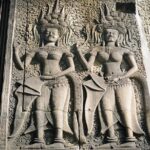
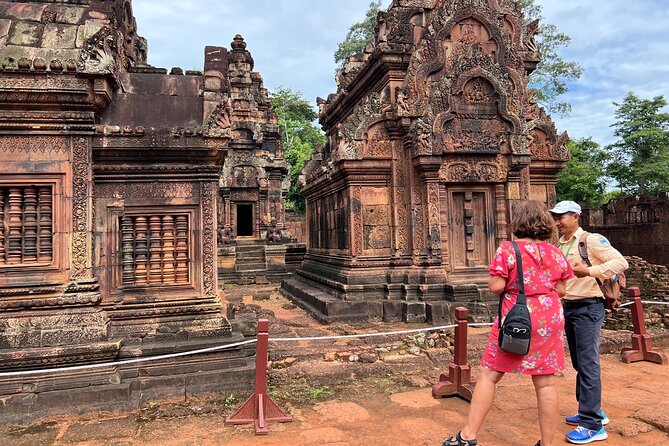
Banteay Srei is the “fine detail” temple of the trip. The tour notes that it’s intricately carved and well preserved, and that the reliefs on this smaller sandstone structure are regarded as the finest and most skillfully crafted.
You’ll have about 2 hours here. That time is important. On many Angkor trips, the smaller temples feel rushed. Here, you can actually step back, look closely, and notice the carving style rather than only the overall shape.
One practical benefit: it happens in the early afternoon window. You’ll still want sunscreen and a hat, but you’re not stuck in the extreme morning dawn fatigue.
The Cambodian Landmine Museum: a short stop with real weight
On the way back toward Siem Reap, the tour stops at the Cambodia Landmine Museum. It’s listed as about 20 minutes, and the museum ticket is $5 per person, not included in the tour price.
This stop is brief on purpose: you’re not going to get a full documentary experience in 20 minutes. But it gives you context for why the ground around Cambodia can be complicated even long after the conflict ended.
How to prepare: treat it as a pause, not a side quest. Go in mentally ready to be affected, and don’t expect the same vibe as the temple ruins. It’s a different kind of learning—one that makes the beauty of the stones feel even more fragile and precious.
Price and value: $160 for the tour, plus what you still need to budget
The listed price is $160 per person for two days. What you’re paying for is not just driving—you’re paying for early sunrise timing, guide guidance in English, air-conditioned transportation, and the meals that prevent you from spending your day hunting food.
Included items worth real money in practice:
- Breakfast on Day 1 with local food
- Lunch on Day 2 (ordering individual dishes from a menu)
- Professional English-speaking guide
- A/C transportation (minivan/minibus)
- Cool water and towels
- Hotel pickup and drop-off
What you need to plan separately:
- The Angkor pass for 2 days/2-visit is not included and is noted as $62 per person.
- The Landmine Museum ticket is $5 per person.
- Food and soft drinks beyond the listed meals aren’t stated as included.
One more value note: the tour is set up so you don’t miss sunrise. Since temple access depends on the pass, getting that handled early protects your schedule. For anyone who hates stress, that alone can justify choosing a guided format.
Comfort, guide style, and the small-group feel
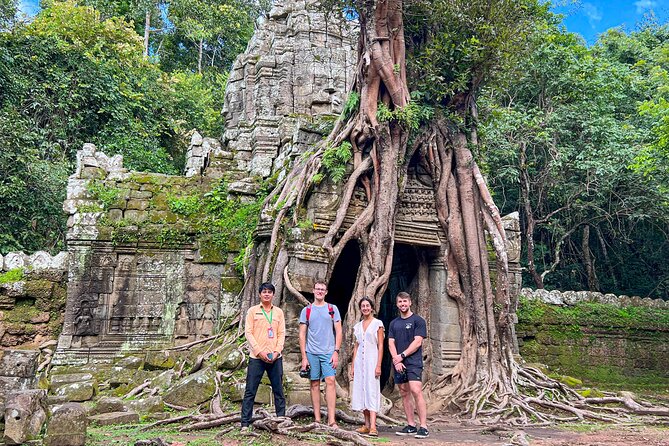
This tour is described as private, meaning only your group participates. Reviews you can use as a guide for expectations highlight friendly, energetic guide personalities—people like Sam and Sinan are praised for keeping energy up without turning temple explanations into stand-up comedy. Others, including Mony, Sareik/Saraik, Sarek, and Jan, are repeatedly noted for making the day feel organized and manageable.
A common thread across praised guide moments: they explain what you’re looking at in a way that helps you connect shapes, symbols, and time periods. Some guides also share personal angles, like life stories tied to being a monk or family experiences during the war—those details aren’t required, but when they happen, they can make the stop feel more grounded than a checklist.
Comfort items also show up as real quality signals. The cold water and cool towels are small, but they’re useful in Siem Reap heat—especially for a day that starts before sunrise.
Also, pickup timing is clearly defined: you wait in the lobby about 15 minutes before the scheduled pickup time. If you’re staying a little outside the center, show up on time anyway so you don’t lose that early start buffer.
Dress code and what to pack for temple days
This tour has a clear rule: no shorts. Your knees and shoulders should be covered.
That’s not just about following rules—it’s about convenience. You’ll walk a lot, and loose long pants and breathable tops are easier than trying to keep adjusting clothes while climbing temple stairs.
Practical pack list based on the schedule:
- Comfortable closed-toe walking shoes (temple walkways can be uneven)
- Light layer for early morning
- Sunscreen and a hat
- Small towel or tissue for dusty moments (cool towels help, but they don’t replace everything)
- A refillable water bottle if you like, even though cool water is provided
If you’re sensitive to heat, plan to slow down at each stop. The tour is efficient, but your body still has to keep up.
Who should book this 2-day Angkor Wat and Banteay Srei tour
I’d point you toward this tour if you want:
- Angkor Wat sunrise without the hassle of planning timing on your own
- A mix of major temples plus smaller, detail-focused ruins
- English guide explanations that help you understand what you’re seeing
- Included breakfast and lunch so you’re not hunting food between stops
You might skip this exact format if you know you struggle with very early starts. Day 1 begins between 4:30 and 5:00 am, and multiple stops are packed into one day. One review notes the experience could be done in a single day because it’s so long—so if you want a slower pace, you’ll feel that.
Also, if you prefer to maximize freedom (hop in and out wherever), a tour like this may feel too scheduled.
Should you book it?
Yes, I’d book this if sunrise at Angkor Wat is a priority and you want the structure of a guide-led plan. The value is strongest when you count the guide, A/C transport, and the included meals, then factor in that you also need an Angkor pass anyway for temple access. The schedule also gives you that satisfying shift from big monuments to the carved detail of Banteay Srei, plus a meaningful context stop at the Landmine Museum.
If you’re well-rested, okay with early mornings, and you want your time in Siem Reap to feel purposeful rather than chaotic, this is a strong fit.
FAQ
Do I need an Angkor pass for this tour?
Yes. The Angkor pass for the 2-day/2-visit option is not included, and the operator requires you to have the pass before the sunrise start so you don’t miss it.
What time is pickup for Angkor Wat sunrise?
Day 1 pickup is between 4:30 am and 5:00 am from your hotel lobby.
Is breakfast and lunch included?
Breakfast on Day 1 is included, and lunch on Day 2 is included (ordering from a menu).
Are temple entry tickets included?
Angkor pass access is not included, and most stops list admission as not included. Your Angkor temple pass is required before the tour starts. The Banteay Srei stop is listed as admission ticket free in the schedule.
Is the Cambodia Landmine Museum ticket included?
No. The museum ticket is listed as $5 per person and is not included.
Is hotel pickup and drop-off included?
Yes. Hotel pickup is included, and you’re transferred back to your hotel after the Day 1 and Day 2 activities.
Can I request a vegetarian meal?
Yes. If you let the operator know in advance, vegetarian options are available for breakfast on Day 1 and lunch on Day 2.
What’s the dress code for the temples?
You shouldn’t wear shorts. Your knees and shoulders must be covered.