REVIEW · SIEM REAP
Private Day Angkor Wat Temple and Banteay Srei Temple Tour
Book on Viator →Operated by Angkor Guide Tour · Bookable on Viator
Angkor feels massive until it’s organized for you. This private day stacks Ta Prohm, Banteay Srei, Angkor Thom, and Angkor Wat into one guided route, with comfortable transport and clear explanations.
I love the practical setup: air-conditioned vehicle, cool water and towels, plus an English-speaking guide who helps you make sense of what you’re seeing. I also like the pacing flexibility that comes with a private format—one guide example (Chanra) has been known to communicate well and adjust the day to what people want to prioritize, and he’s also helped visitors with limited mobility find workable ways to get closer to key areas.
One consideration: the 1-day Temples Pass is not included (listed at $37 per person), so your real total cost will be higher than the $43 tour price.
In This Review
- Key highlights to plan for
- How the private format changes your Angkor day
- Price and the real budget: $43 plus the Temples Pass
- Stop-by-stop: what you’ll see and why it’s worth your time
- Ta Prohm: jungle roots and a monk’s-eye vibe
- Pre Rup: a state temple with a timing story
- Banteay Srei: pink sandstone and fine carving
- Angkor Thom South Gate: the moat crossing and the naga line
- Bayon: 173 faces and the debate factor
- Baphuon: the state temple inside the royal core
- Phimeanakas and the royal enclosure vibe
- Terrace of the Elephants: over 300 meters of power
- Terrace of the Leper King: the boundary and the setting
- Angkor Wat: the cosmic design climax
- Timing, comfort, and the reality of walking
- What makes the guide time worth it
- Who this private day works best for
- Should you book this private Angkor Wat and Banteay Srei day?
- FAQ
- How long is the Private Day Angkor Wat Temple and Banteay Srei Temple Tour?
- What is the price per person?
- What is included in the tour price?
- Do I need to buy a Temples Pass?
- Which temples are included in the day?
- What are the operating hours?
- Is this tour private?
- Is there a cancellation option if plans change?
Key highlights to plan for
- Private routing that fits your group, not a giant bus schedule
- English guide plus A/C comfort, including cool water and towels
- Art and symbolism: Angkor Wat’s cosmic design and Banteay Srei’s 10th-century Shiva carvings
- A full Angkor Thom sweep, featuring Bayon’s 173 faces and long royal terraces
- A day that blends jungle, pink stone, and grand city architecture without you figuring it out alone
- Real-world adaptability, including advice and logistics help when walking is tough
How the private format changes your Angkor day
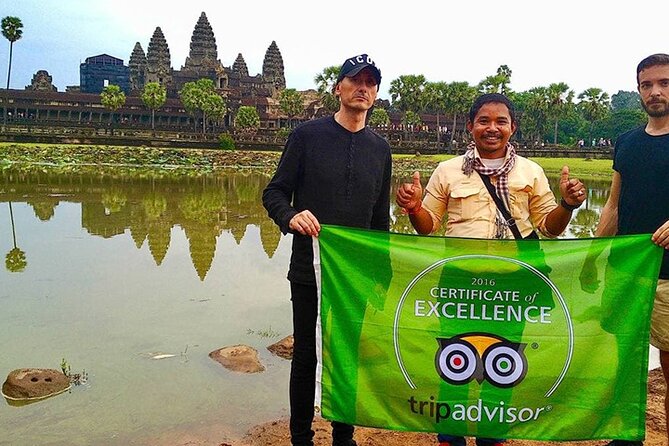
Angkor can feel like a puzzle with too many pieces. In this private setup, you’re not just moving from temple to temple—you’re getting guidance on what to look for and in what order the visuals make the most sense. That matters when you’re dealing with big crowds at some sites and long walks between others.
You also get to keep the day working for your group. If you care more about carvings than big views, or you want extra time at a single stop, you’re not stuck waiting your turn. In a place like Angkor, that flexibility is often the difference between seeing a lot and truly noticing the details.
You can also read our reviews of more private tours in Siem Reap

Price and the real budget: $43 plus the Temples Pass
The tour price is $43 per person, and it runs about 8 hours 30 minutes. That includes the guide, A/C transport, parking and tolls, plus cool water and towels, and it also lists pickup and drop-off at the airport.
Then there’s the separate Temples Pass: $37 for a 1-day pass. So you should budget roughly $80 per person total for the day (before any extras like snacks). It’s still good value if you want a guided route through several major sites, because the guide helps you spend your time well instead of guessing.
Stop-by-stop: what you’ll see and why it’s worth your time
Ta Prohm: jungle roots and a monk’s-eye vibe
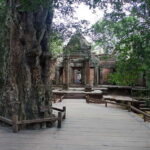
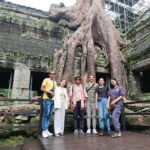
Your day begins at Ta Prohm, a royal monastery originally known as Rajavihara, meaning monastery of the King. It dates to 1186 AD and functioned as a Mahayana Buddhist monastery and university, so it’s not just a pretty ruin—it’s a reminder that this area wasn’t empty centuries ago.
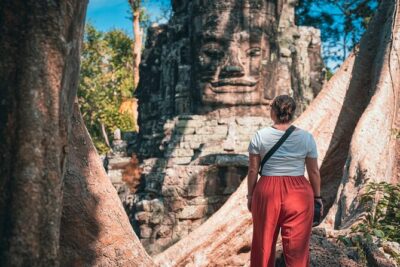
The main reason Ta Prohm hits so hard is the contrast: stone and then the jungle doing its own thing. Expect vines resting over structures and large tree roots stretching along the ground and up through the ruins. It’s a temple that looks like it was designed to be read slowly, because the vegetation creates its own paths and frames.
Practical tip: this is a walking-and-looking stop. Wear shoes you’re comfortable scuffing a bit, because surfaces can be uneven.
Pre Rup: a state temple with a timing story
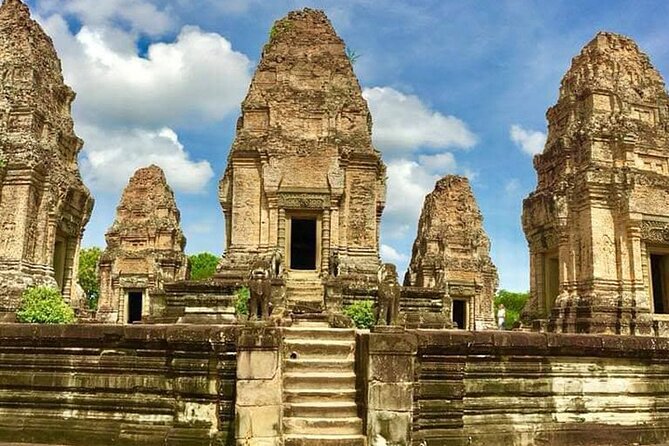
Next is Pre Rup, built as the state temple for King Rajendravarman in the late 10th century. The dates commonly given are 961 or 962 AD, and it was built about nine years after East Mebon, roughly 1.3 km north.
Pre Rup is shorter on time (about 20 minutes), but it’s a good breather stop in the middle of a long day. It also helps you connect the dots between different eras of Khmer building—especially when you’ve just seen the dramatic jungle presence at Ta Prohm.


Banteay Srei: pink sandstone and fine carving
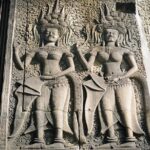
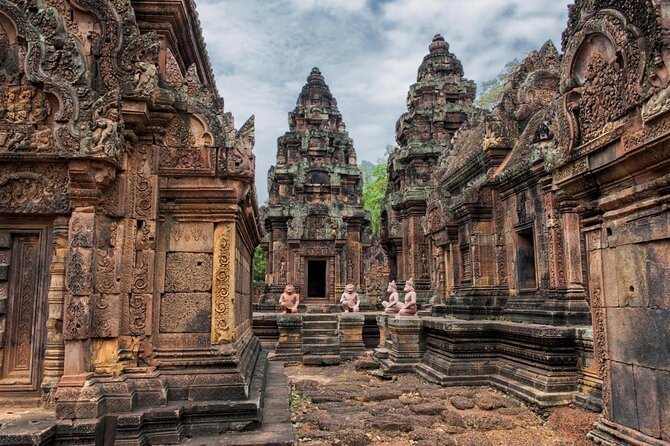
Then you head to Banteay Srei, also called the Temple of Women and known as the Pink Ladies Temple. It’s a 10th-century Hindu temple dedicated to Shiva, and it’s famous for Khmer artistry—motifs, figures of gods, and detailed carving work.
This temple is smaller than many others in the region, which is part of the appeal. Instead of only competing with crowds for your attention, you can often take in the craftsmanship more closely. If you like when history shows up in the tiny stuff—like faces, patterns, and repeated motifs—Banteay Srei is where you’ll feel satisfied.
Timing note: the stop is about an hour, so you won’t get lost without a plan. That’s a good thing here, since the beauty can pull you in every direction.
Angkor Thom South Gate: the moat crossing and the naga line
After Banteay Srei, you move into Angkor Thom via the South Gate. You approach across a grand causeway that crosses a 100 m wide moat. On both sides, you’ll see a naga balustrade, which begins with a massive stone carving of a seven-headed naga.
The gate is more than a photo moment. It’s your transition point from the outer world into the royal heart of Angkor Thom. The scale of the entry makes the next stops feel like a real arrival, not just another ruin in a checklist.
Bayon: 173 faces and the debate factor
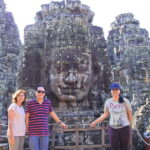
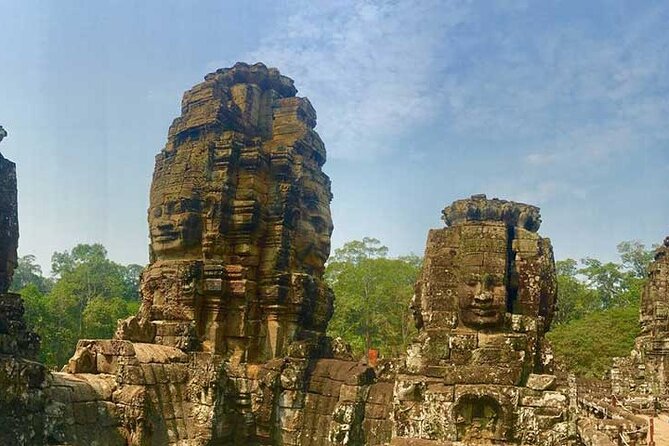
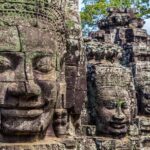
Inside Angkor Thom, you’ll reach Bayon Temple, where 173 gigantic faces remain on the towers. Even today, there’s debate about who those faces represent, and that uncertainty is part of Bayon’s intrigue.
Bayon’s face towers create a weirdly persuasive effect. From different angles, the expression can feel different, and your brain tries to solve who is looking back at you. It’s one of the temples where a guide’s explanation can genuinely help, because you’re not just staring—you’re learning what to notice.
Stop length is about 50 minutes, which is enough time to walk, orient yourself, and pick a couple of angles without rushing.
Baphuon: the state temple inside the royal core
You then visit Baphuon, described as the state temple of King Udayadityavarman II. It sits in Angkor Thom between the Royal Palace and Prasat Bayon.
Baphuon tends to feel different from Bayon. It’s more about architecture and monument presence than faces everywhere. If you’ve spent time staring at close-up carvings at Banteay Srei, Baphuon lets your eyes reset.
Phimeanakas and the royal enclosure vibe
Next comes Phimeanakas, part of the royal enclosure. It’s a temple with a story attached to it, and the idea of being inside the royal grounds adds context to what you’ve been looking at.
This stop is about 30 minutes. That’s a realistic amount of time here because Phimeanakas can be easy to overrun if you’re tired—especially after a day of walking.
Terrace of the Elephants: over 300 meters of power
You’ll then see the Terrace of the Elephants, built by King Jayavarman VII at the end of the 12th century. The terrace stretches more than 300 meters, from the Baphuon in the south toward the Leper King terrace to the north.
Terraces like this help you understand Angkor as a functioning ceremonial space. These weren’t just buildings; they were stages. Even if you don’t know every carved detail, the sheer length and layout make the place feel deliberate.
Terrace of the Leper King: the boundary and the setting
Finally, you reach the Terrace of the Leper King. Together, the Terrace of the Elephants and the Terrace of the Leper King form the Eastern boundary of the royal palace grounds. This one is shorter (about 15 minutes), so you’ll use it as a finish-line stop before Angkor Wat.
Short stop doesn’t mean insignificant. In Angkor Thom, boundaries and layout are part of the story, and terraces help you see the whole picture even when time is tight.
Angkor Wat: the cosmic design climax
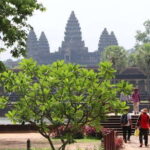
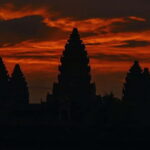
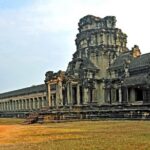
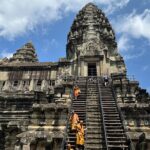
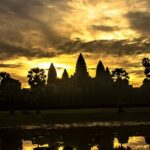
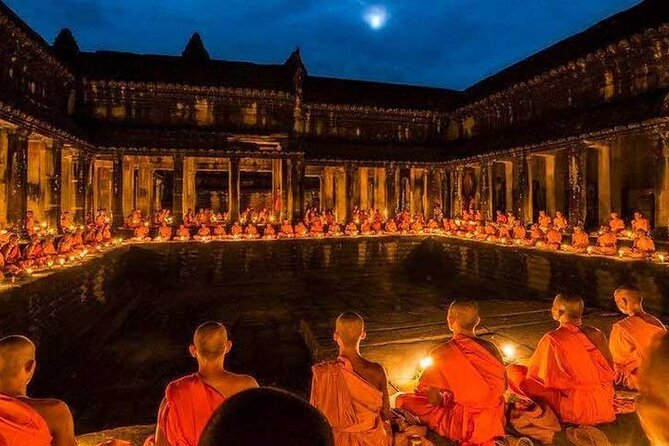
Your day ends at Angkor Wat, the big finale. It’s described as representing the abode of Hinduism’s ancient gods, and it’s the largest of Angkor’s temples.
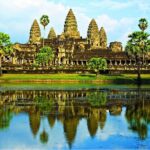
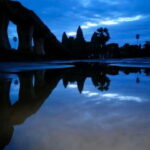
Angkor Wat has five concentric rectangular walls with moats alongside. That arrangement symbolizes a cosmic chain of mountains and ocean. The central tower represents Mount Meru, the mountain said to be the center of the Hindu and Buddhist universe.
That symbolism isn’t academic. It changes how you experience the place. When you understand that the geometry is the point—not just the beauty—you start noticing how the view corridors and levels guide where your eyes go.
You’ll spend about 3 hours here, which is the right amount for Angkor Wat. Too short and you’ll feel rushed. Too long and you can miss the value of the structure by getting lost in single angles.
Timing, comfort, and the reality of walking
This is a full day—10 distinct stops, including one major marathon visit at Angkor Wat. The listing places the day within 8:00 AM to 4:00 PM operating hours, so you’ll likely be moving through temples while it’s still bright and warm.
That’s why the included basics matter. Air-conditioned vehicle plus cool water and towels can keep the day enjoyable instead of turning it into a heat test. And since this is private, you don’t lose time regrouping after everyone wanders off.
Still, assume plenty of steps and uneven ground. Even the “smaller” temples like Banteay Srei involve walking and looking. If anyone in your group has mobility needs, it’s worth discussing your situation in advance—there’s a real example of a guide helping someone on crutches use closer access and smaller vehicles so the person could still see the sites.
What makes the guide time worth it
A good Angkor guide does two things: they help you see details faster, and they give you the story behind the layout so the temples feel connected.
Here, the tour description gives you themes to look for—cosmic design at Angkor Wat, Shiva dedication and fine carving at Banteay Srei, and the jungle-vines spectacle at Ta Prohm. A guide turns those into moments you can recognize on the spot, like understanding why those walls and moats matter or why the faces at Bayon create so much conversation.
It’s also a practical comfort. The guide helps with the flow of the day so you aren’t stuck trying to read signs, track entrances, or decide where to go next while you’re already tired.
One specific name you might run into with this provider is Chanra, who has been described as communicating clearly via WhatsApp and customizing based on what people want to see. That kind of back-and-forth can be a lifesaver when you’re trying to squeeze the right temples into one day.
Who this private day works best for
This tour makes the most sense if you want a lot of major Angkor sites without the stress of planning every turn. It’s a solid fit for couples, small families, and solo travelers who like structure but don’t want a crowd-style day.
If your group includes someone who struggles with long walking distances, you’ll likely have the best result if you bring it up early. The tour can involve vehicle access and on-the-ground adjustments, and a guide has done logistics that helped someone on crutches access key areas rather than skipping most of the day.
If you’re the type who wants only one or two temples and zero rushing, you might still enjoy this—but you’d probably feel the pace. In this route, the goal is variety and coverage, with Angkor Wat as the long anchor at the end.
Should you book this private Angkor Wat and Banteay Srei day?
Book it if you want a guided, efficient day that hits Ta Prohm, Banteay Srei, Angkor Thom, and Angkor Wat with comfortable transport and explanations that connect symbolism to what you see. The included comfort items and the private format help the day feel manageable instead of chaotic.
Skip it or adjust your expectations if your budget is tight. Once you add the $37 Temples Pass, the day’s cost rises, and the itinerary is still active even with vehicle comfort.
If you’re aiming for one high-value Angkor day in Siem Reap, this is a strong choice—especially because it doesn’t treat temples like random stops. It strings them into a single story from jungle ruins to royal city core to the cosmic centerpiece.
FAQ
How long is the Private Day Angkor Wat Temple and Banteay Srei Temple Tour?
It runs about 8 hours 30 minutes.
What is the price per person?
The tour price is listed at $43.00 per person.
What is included in the tour price?
Included items are an air-conditioned vehicle, an English tour guide, parking fees and roads tolls, cool water and towels, and pickup/drop-off at the airport.
Do I need to buy a Temples Pass?
Yes. The Temples Pass is not included, and it’s listed as $37.00 per person for a 1-day pass.
Which temples are included in the day?
The stops include Ta Prohm, Pre Rup, Banteay Srei, Angkor Thom South Gate, Bayon, Baphuon, Phimeanakas, Terrace of the Elephants, Terrace of the Leper King, and Angkor Wat.
What are the operating hours?
The experience is listed as running Monday through Sunday from 8:00 AM to 4:00 PM.
Is this tour private?
Yes. It’s a private tour/activity, and only your group participates.
Is there a cancellation option if plans change?
Yes. Free cancellation is available, and you must cancel at least 24 hours in advance for a full refund.